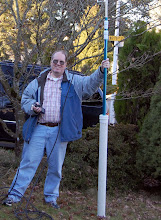
Radio still seems like magic to me. In my early teenage years, I listened to distant AM radio stations on a small radio. On some nights the stations came in clearly, and other nights not at all. Today, my antennas and radios are much larger and more sensitive, but I still feel the magic. I may listen to friends across town, or talk with someone perched on a small atoll in mid-Pacific Ocean, or talk with someone commuting the highways in a far-away city. Once I talked for nearly an hour from Vancouver with a ham on Lake Powell who described a lovely sunset from his part of the world.
Many hams earned their license to help communicate during times when their community needed help. During and after the windstorms along the Oregon coast in December 2007, ham radio operators dispatched police, fire, and other county personnel because the county radio system failed. Many of the hams who served along the coast were relatively new, and they used simple radio systems. After the Gulf hurricanes in 2005, hams helped rescue and support agencies with needed communications. Most communities lost their local public service communication facilities from wind and water damage, so ham radio filled the gap.
Ham radio operators often help with non-emergency events such as parades and large events like the Hood-to-Coast relay. The race course covers over 190 miles. Hams set up at most checkpoints which are 6-8 miles apart. They handle emergency and health-related communications along the route. Hams do this without pay as a community service.
The hams I’ve met all seem genuinely nice and helpful, and are usually willing to share what they know to help other hams. I’m sure some do not fit this pattern, but those folks apparently avoided meeting me. Most are willing to answer questions from a newbie, or help in the community when needed.
Ham radio includes many sub hobbies. Some became hams so they could communicate during search and rescue events. Others earned their license to help learn electronic principles and experiment (cell phones, and cable TV came from such experimentation). Still others joined so they could talk with people in distant places. My personal interests include using radios to support community and church events, participating in radio contests to improve my operating skill, and helping others earn their licenses. Sometimes I try my hand at building antennas with some modest success.
Ham radio provides a framework to learn many interesting things about our world. When I talk with someone in a distant place, I often look on a map to find where the other person lives. Radio waves obey physical laws, some of which we know little about. Some days I can talk easily with people in Denver, or Atlanta, and other days all I hear is static from the atmosphere energized by our sun. During a single day, I might hear east coast stations for several hours, and then as they fade away, stations from the Great Plains replace the east for a while before those stations, too, fade away into the noise. Is it magic? I still think so.
Thursday, October 27, 2011

Four ham radio contacts, all different
A few days ago while I worked on my bills and sorted through some receipts to post, I turned on the radio nearby and dialed around on the 20-meter band (about 14.250 MHz). I listened for quite a while as a ham in Green River, WY talked with Cub and Boy Scouts in several California cities. He was a former professional scouter, served in the Army, and sounded like an interesting fellow.
When N7COA left the air I twiddled the dial some more and heard a station in NY who was participating in the NY QSO party (see Note 1 below). I called W2CCC, he answered, and the contact was over. I will likely send a QSL card to confirm the contact.
Then I dialed around some more and heard a special event station at a Wildlife Refuge in Homer, AK. I called K7P and we chatted for a bit. I definitely will send a QSL card (see Note 2) and possibly $2 for a nice certificate about the refuge.
Again, I spun the dial and heard a station with an unusual call sign: T32C. I looked up the call sign and discovered they were transmitting from Christmas Island in the Pacific near the equator. I just confirmed my call sign is in the log! This is a new ham country for me (see Note 3).
A couple days ago I talked with some local friends using the 2-meter band. Two-meter signals can travel long distances, but not half way round the world. Technicians have full use of all the ham bands above 30 MHz, plus small segments in the HF bands. General and higher licensees can use the HF bands to talk around the world when conditions are right.
I enjoyed my three casual contacts.
Note 1: A QSO is a contact between hams. A QSO Party encourages hams to contact other hams within the QSO Party boundaries (in this case New York). Hams within the boundary contact anyone. This is one way to increase the number of county contacts, and helps me learn some geography.
Note 2: QSL cards can be simple (call sign, names, date and time of contact, band or frequency, and usually mode (single sideband, CW, etc.). Some cards have beautiful photos that show the area where the ham lives. The cards confirm a contact between hams.
Note 3: Hams count countries differently than the UN or geographers. Portions of countries (such as AK and HI) separated from the rest of the country by some distance (I think 100 miles, but not sure) count as different countries. So a person who works all 50 states will have 3 DX countries in the bag.
When N7COA left the air I twiddled the dial some more and heard a station in NY who was participating in the NY QSO party (see Note 1 below). I called W2CCC, he answered, and the contact was over. I will likely send a QSL card to confirm the contact.
Then I dialed around some more and heard a special event station at a Wildlife Refuge in Homer, AK. I called K7P and we chatted for a bit. I definitely will send a QSL card (see Note 2) and possibly $2 for a nice certificate about the refuge.
Again, I spun the dial and heard a station with an unusual call sign: T32C. I looked up the call sign and discovered they were transmitting from Christmas Island in the Pacific near the equator. I just confirmed my call sign is in the log! This is a new ham country for me (see Note 3).
A couple days ago I talked with some local friends using the 2-meter band. Two-meter signals can travel long distances, but not half way round the world. Technicians have full use of all the ham bands above 30 MHz, plus small segments in the HF bands. General and higher licensees can use the HF bands to talk around the world when conditions are right.
I enjoyed my three casual contacts.
Note 1: A QSO is a contact between hams. A QSO Party encourages hams to contact other hams within the QSO Party boundaries (in this case New York). Hams within the boundary contact anyone. This is one way to increase the number of county contacts, and helps me learn some geography.
Note 2: QSL cards can be simple (call sign, names, date and time of contact, band or frequency, and usually mode (single sideband, CW, etc.). Some cards have beautiful photos that show the area where the ham lives. The cards confirm a contact between hams.
Note 3: Hams count countries differently than the UN or geographers. Portions of countries (such as AK and HI) separated from the rest of the country by some distance (I think 100 miles, but not sure) count as different countries. So a person who works all 50 states will have 3 DX countries in the bag.
Sunday, May 15, 2011
Radio magic with DX
This morning when I sat down at my desk to organize my workplan for the day and week, I turned on the radio to just listen. I twiddled the dial on 20 meters and heard nothing but static, so I tried 40 meters. A few stations were on but nothing that interested me, so I went back to 20 meters, and after a bit of hunting, heard a distant (DX) station working North American stations in succession.
Before I go further, let me briefly describe my station so you get a feel for the situation. I have an Icom 706 MkIIG that runs on batteries below my desk (they are heavy!). My feedline snakes out the window (haven't cut a hole in the wall yet) without a tuner and connects to a short feedline for a G5RV antenna. The wire slopes from 40' atop my garage to 30' diagonally across my home (mainly so my wife does not complain about the appearance). Simple station with minimal directivity.
I've learned with experience that when stations sound relatively loud at my location, I have a chance to talk with them. Maybe. John was not loud, but definately readable. As I listened to John work several stations per minute in what sounded like a relaxed manner, the thought crossed my mind that I should at least call him once or twice. Perhaps my signal would be strongest at his end for a brief moment. As John finished with a station, he would then say QRZ (which means who is calling me?). That was my cue.
I said my call sign phonetically but he answered another station. So I tried again on the next round, and he said MY callsign! We exchanged brief pleasantries and signal reports at 1014 Z May 15, 2011. The magic part is how a thin wire hung between metal poles about 75 feet apart allowed me to talk briefly with a station 7300 miles around the world. John, 9M6JC, was speaking from Borneo Island in Malaysia just 5° north of the equator and I live slightly north of halfway to the pole. So far this is the longest distance I've talked. I sure like ham radio as a hobby. Now I need to figure out the island identifier for IOTA (Islands on the Air).
I have a number of friends who have talked with nearly all entities (countries and country segments) around the world. Currently there are 337 recognized "ham countries". To put this contact into perspective, Borneo is my 12th ham country. I doubt I will ever have all of the countries confirmed, but certainly will not unless I get on the radio, listen, and try. Yesterday I heard a station from Croatia for the first time, so I'll keep listening. There is magic in the ether!
Before I go further, let me briefly describe my station so you get a feel for the situation. I have an Icom 706 MkIIG that runs on batteries below my desk (they are heavy!). My feedline snakes out the window (haven't cut a hole in the wall yet) without a tuner and connects to a short feedline for a G5RV antenna. The wire slopes from 40' atop my garage to 30' diagonally across my home (mainly so my wife does not complain about the appearance). Simple station with minimal directivity.
I've learned with experience that when stations sound relatively loud at my location, I have a chance to talk with them. Maybe. John was not loud, but definately readable. As I listened to John work several stations per minute in what sounded like a relaxed manner, the thought crossed my mind that I should at least call him once or twice. Perhaps my signal would be strongest at his end for a brief moment. As John finished with a station, he would then say QRZ (which means who is calling me?). That was my cue.
I said my call sign phonetically but he answered another station. So I tried again on the next round, and he said MY callsign! We exchanged brief pleasantries and signal reports at 1014 Z May 15, 2011. The magic part is how a thin wire hung between metal poles about 75 feet apart allowed me to talk briefly with a station 7300 miles around the world. John, 9M6JC, was speaking from Borneo Island in Malaysia just 5° north of the equator and I live slightly north of halfway to the pole. So far this is the longest distance I've talked. I sure like ham radio as a hobby. Now I need to figure out the island identifier for IOTA (Islands on the Air).
I have a number of friends who have talked with nearly all entities (countries and country segments) around the world. Currently there are 337 recognized "ham countries". To put this contact into perspective, Borneo is my 12th ham country. I doubt I will ever have all of the countries confirmed, but certainly will not unless I get on the radio, listen, and try. Yesterday I heard a station from Croatia for the first time, so I'll keep listening. There is magic in the ether!
Tuesday, October 20, 2009
Ham webinars
Earlier today I ran across a reference to webinars on ham radio subjects presented by the Potomac Valley Radio Club (www.pvrc.org). At the top of the page there is a link labelled PVRC Webinars. Click on that and it will take you to another site with several (currently 7) webinars. I partly watched and mostly listened to three of the presentations. I was impressed by the expertise and knowledge of the presenters, and learned some things I did not know. The three I watched were:
- Cycle 24... and more by Carl Luetzelschwab, K9LA
- Welcome to contest antennas: DX or domestic. What's your pleasure by Dean Straw, N6BV
- When giants first walked the bands; the early days of multi-multi by Doug Zweibel, KR2Q
The first presentation gave me just enough information to encourage me to learn more. There is a related presentation that will be available soon. Dean Straw demystified some aspects of antenna arrays, but I doubt I will ever have the real estate to create some of the large antennas he discussed. The third presentation was a history lesson on large contest stations from the 60's to mid-80's. Interesting photos and the speaker knew many of the folks shown personally.
The webinar idea intrigues me, and I plan to explore ways that our club might consider doing something like this. Technically it should be feasible, but whether there are folks who could pull it off is another topic.
Keep learning.
Friday, September 18, 2009
Northwest ham populations

The ham radio ranks continue growing in the Northwest. Over the past several months I've analyzed the number of ham licensees as the basis for a class project in school. I found the analysis both interesting and challenging.
The ham population roughly tracks the general population in the Northwest (defined and Oregon and Washington for this purpose), although there are anomalous pockets.
The map above shows the high ham concentration in three Puget Sound counties. The Portland metro area and Spokane also have high ham numbers. Two counties in SE Washington and three in North Central Oregon have very low numbers. These counties might be places to operate during state QSO parties or during county hunter activities. I expect quite a few folks would appreciate a few stations operating from those counties.

I found the map below much more interesting. The map shows the number of hams per thousand in the general population (based on the 2008 US Census county estimates). On the low end, many counties with low ham numbers also have low numbers per thousand. This may simply be the result of few hams who talk about their hobby, so few folks in the county get interested.
On the other side, the coastal counties of NW Washington and NW Oregon stand out. I know several clubs along the coast actively seek out hams for emergency communications, and local newspapers wrote several stories on ways hams helped their communities during storms.
Both Oregon and Washington have some of the highest ham population growth over the past several year, surpassed only by Utah, Idaho, and Nevada.
DX serendipity
On my home from the Ham Basics workshop (see previous post), I turned on the radio in my car to see what stations might be on the air. I was pleasantly surprised to hear several European stations booming in. To say this is rare for my mobile station would be an understatement! I had heard a Finnish station once before a year or more ago, but none others.
I've also learned that my chances of working a weak station from my car (I have a hamstick mounted near the trunk with a line tuner between the antenna and radio) approach nil. Since the station was loud enough, I called DL7MEV (he was in a contest) and he even answered back. I now have exactly ONE European contact from Germany near the Austrian border.
Since that time, I have not heard any stations more distant than Texas and Minnesota (about 1500 miles). That magic of radio continues....
Postscript: I uploaded my German contact into Logbook of the World, and he verified the contact a couple of days later. I assume he needed some rest after a 48-hour contest. Now my trail towards DXCC advances to 14. Just for comparison, several of my friends have contacts with 337 countries verified, so I have a ways to go.
I've also learned that my chances of working a weak station from my car (I have a hamstick mounted near the trunk with a line tuner between the antenna and radio) approach nil. Since the station was loud enough, I called DL7MEV (he was in a contest) and he even answered back. I now have exactly ONE European contact from Germany near the Austrian border.
Since that time, I have not heard any stations more distant than Texas and Minnesota (about 1500 miles). That magic of radio continues....
Postscript: I uploaded my German contact into Logbook of the World, and he verified the contact a couple of days later. I assume he needed some rest after a 48-hour contest. Now my trail towards DXCC advances to 14. Just for comparison, several of my friends have contacts with 337 countries verified, so I have a ways to go.
Ham Basics Workshop

Last weekend our radio club held a workshop entitled "Ham Basics" with the concept to teach beginning principles on a variety of ham radio subjects. I did most of the planning and prep work behind the scenes, but asked for help with publicity and logistics for the building. In all, we had nine instructors who taught 13 classes: one general session (45-minutes) and 12 50-minute classes. We all met together for the general session, then separated into four classrooms where the other classes were held. I am grateful for the willingness of the instructors to prepare material and teach to the attendees.
We started at 9 AM in a large hall with about 80 attendees who watched several of us solve a projector problem early in my session. Most attendees were licensed hams, but there were some who came to "kick the tires" and learn a bit about the hobby. Many of the presentation outlines are available at http://www.w7aia.org/class.htm in case you are interested in the subjects. [Note: the workshop web page is not well-organized yet, but hopefully I can negotiate with the webmaster to improve it.] The slide that shows how few hams reside in some counties surprised many folks; the large ham population in the Puget Sound area and in the Portland metro area should not surprise anyone.
After the general session, attendees were able to choose from four classes. During the first class session, we offered "How to get the most from your handheld", "Simple VHF/UHF antennas", "Communications during an Emergency", and "Getting started with HF".
During the second class period, we offered "Operating mobile and portable", "Connectors and grounding", "Digital communications", and "Simple HF antennas".
During the third period, we offered "Station types from handheld to HF", "Contesting", "Using your radio for public service", and "Care and feeding of batteries".
In all, we had between 85 and 100 folks attend for all or part of the workshop. Attendees ranged from unlicensed to extra, although I think most attendees held either technician or general licenses. We received numerous thanks for the session, enough to seriously consider doing it again next year. I learned from preparing the classes, and sitting in on one class.
Wednesday, August 12, 2009
Ham Basics workshop planning
A few months back a friend and I were discussing some ways to help new hams get on the air with more confidence. Many of our past students needed just a "little bit more" help to get their radios set up properly for their first contact. After some thought, we came up with the idea of a four-hour workshop on a Saturday that would provide several short classes for folks.
Initially I thought we should have four class sessions, but several friends kept mentioning some things they thought everyone should hear. So, I changed my thinking with a general session (sometimes called a plenary session) at the beginning followed by three class periods of 50 minutes each. Since hams by nature are a rather gregarious group, the plan included 10 minutes between classes with a longer time between the second and third class session for a short break.
Then I started brainstorming to come up with at least a dozen class titles that sounded interesting. When I started showing the list around, I got more suggestions (very helpful) and some volunteers to teach one or more sessions. The classes tend to focus on areas that cause beginners to stumble. Hopefully the classes will trim the hurdle heights somewhat. The classes on the program so far include in no particular order:
Initially I thought we should have four class sessions, but several friends kept mentioning some things they thought everyone should hear. So, I changed my thinking with a general session (sometimes called a plenary session) at the beginning followed by three class periods of 50 minutes each. Since hams by nature are a rather gregarious group, the plan included 10 minutes between classes with a longer time between the second and third class session for a short break.
Then I started brainstorming to come up with at least a dozen class titles that sounded interesting. When I started showing the list around, I got more suggestions (very helpful) and some volunteers to teach one or more sessions. The classes tend to focus on areas that cause beginners to stumble. Hopefully the classes will trim the hurdle heights somewhat. The classes on the program so far include in no particular order:
- How to get the most from your handheld radio.
- Connectors and grounding.
- Simple VHF/UHF antennas.
- Simple HF antennas.
- Getting started with HF radio.
- Station types from handheld to HF.
- Operating mobile and portable.
- Operating in a contest.
- Care and feeding of batteries.
- Using your radio for public service.
- Digital communications.
- Communications during an emergency.
To date I have instructors for all but three classes. I hope to hear a positive answer from a potential instructor on one of those classes soon, so I have two more instructors to find.
A session like this would not be possible without a decent-sized venue. I gained permission to use a large church meetinghouse with rooms that can accommodate the general session and the classes. I think we could have up to 75 or so in some classes, depending on how many folks are interested in the program. The facility allows us to charge nothing for the event. Frugal (and sometimes cheap) hams should like that cost!
I am grateful for ten instructors so far agreeing to present one or more classes to help hams learn more about the hobby. The event will occur next month, and I plan to write about the results. My goal is to provide learning opportunities for new and experienced hams so we get better together.
During the general session, I plan to cover general principles for good electronic communication. I also plan to show where hams fit in the Incident Command System (ICS), mention good repeater protocol, a reminder about only using frequencies authorized to each licensee, family emergency communications plans (you have one, right?), and some related topics.
Once the publicity goes out later this week to the all and sundry, we will see how many folks are interested. Publicity for events like this are crucial for success. Fortunately a friend from our radio club will handle that part, and she manages to reach many people. For an event last year, our antenna seminar publicity reached the deep south from way up here in the northwest.
May you always be prepared for the unexpected, and enjoy the journey.
Saturday, July 25, 2009
Backyard Portable

A friend loaned me his SuperAntennas MP1 portable vertical to try out. My week did not go quite as planned (do they ever?), so it was Saturday before I gave it a try. My friend also loaned me a 35 amp-hour battery pack. I recently rehung my G5RV antenna across the house, so thought I would try both antennas during the IOTA contest on battery power.
I toted the battery, radio, antenna switch, coax, and the MP1 to the picnic table and started setting up my station. First, I attached more coax between the G5RV and the antenna switch. Then I connected the antenna switch to the radio with a short piece of coax. For the power, Anderson PowerPoles sure make painless and quick connections. A satisfying "click" and then atmospheric noise indicated the battery had juice and the radio detected same.
Then I read the one page instruction for the MP1. The instructions are adequate for the antenna. I screwed the two rods to the base, attached the whip to the tuning coil, then screwed the coil to the rods. I set the base edge under the battery on the assumption the heavy battery would keep the MP1 vertical, and spread out the four counterpoise radial wires. After I connected the coax, it was ready to test.
I found that the MP1 heard many stations that I could not hear on the G5RV. The G5RV heard more static than the MP1. I heard several loud stations including VC8B on Baker Island in northern Canada (unfortunately he did not hear me), W6AFA in Los Angeles, and a few other stations. No one I called heard me, so Idid not receive any signal reports.
I listened and called for a while, then decided to do other things. After I dismantled the station, I started wondering if the G5RV is still working. That is an open question.
A few things I learned from the short experience:
I toted the battery, radio, antenna switch, coax, and the MP1 to the picnic table and started setting up my station. First, I attached more coax between the G5RV and the antenna switch. Then I connected the antenna switch to the radio with a short piece of coax. For the power, Anderson PowerPoles sure make painless and quick connections. A satisfying "click" and then atmospheric noise indicated the battery had juice and the radio detected same.
Then I read the one page instruction for the MP1. The instructions are adequate for the antenna. I screwed the two rods to the base, attached the whip to the tuning coil, then screwed the coil to the rods. I set the base edge under the battery on the assumption the heavy battery would keep the MP1 vertical, and spread out the four counterpoise radial wires. After I connected the coax, it was ready to test.
I found that the MP1 heard many stations that I could not hear on the G5RV. The G5RV heard more static than the MP1. I heard several loud stations including VC8B on Baker Island in northern Canada (unfortunately he did not hear me), W6AFA in Los Angeles, and a few other stations. No one I called heard me, so Idid not receive any signal reports.
I listened and called for a while, then decided to do other things. After I dismantled the station, I started wondering if the G5RV is still working. That is an open question.
A few things I learned from the short experience:
- Set-up went quickly when the necessary parts are close at hand.
- Battery-powered operation has some benefits, such as no AC power cord and power supply to handle. This allows operation most anywhere so long as the battery has adequate juice.
- The MP1 has potential, as yet unrealized. I think another portable antenna type may meet my operating methods better than the MP1, but I need to try it again.
- Operating outside on a pleasant warm day is much more interesting than operating from my normal shack.
Sunday, June 7, 2009
SeaPac 2009 in Seaside
My wife and I drove from home to Seaside, Oregon for the 2009 ARRL NW Division conference. the drive west through the forests in Tillamook Burn towards the coastal gray sky reminded us both of our time at school some years ago. Once at Seaside, I headed to the Convention Center for a two hour security assignment. That was the time vendors and fleamarketeers set up their tables. The hall looked like a beehive.... After my shift, we went hunting for geocaches in the area.
On Saturday, I walked the dozen or so blocks from our lodging to the Convention Center. I talked with several other hams in the lobby while waiting for the doors to open at 9 AM. Promptly at 9, security removed the barrier and the crowd surged into the hall. I took a side trip to visit with the OR and WA frequency coordination group leaders. I gained a better appreciation for the role of frequency coordination, and found them willing to consider reasonable proposals. I would like to see more simplex frequencies available in the metro area for use during emergencies, but most repeater owners (who make up the repeater council) want more, not less, repeater frequencies. I plan to send a firm proposal later this week.
Next I headed upstairs for my talk on ham training. In my talk, I started off with seven maps that show ham demographics in the US. California has the most hams, but their ham population declined by over 12,000 in the past decade. Washington state has the second highest hams per thousand in the general population behind Alaska. Ham populations in many states declined, while the ham population in the NW increased over the past decade. The western states have a higher proportion of female hams than most other states. At the current growth rate ,Washington should attain the fifth highest ham population in the US. We continue to increase ham numbers while other areas are in decline.
After the demographics, I suggested methods for effectively teaching ham classes. We had some good discussion on teaching methods. The had about 60 seats and about 3/4 were occupied, which is more than triple than last year. I plan to polish the discussion and submit an article to QST.
After my talk, I visited nearly every commercial booth to check out their wares. The new Icom HF radios (http://www.icomamerica.com/) look quite interesting but spendy. Maybe my interests and bank account will converge one of these days. Ham Radio Outlet (http://www.hamradio.com/) sold quite a few new radios; a friend bought an Icom 7000 (nice radio), and another friend bought a Yaesu FT-8900 quad band FM radio. I think both of my friends will be happy with their choices. One of these days I may sell one of my radios and trade up.
The Buddipole antennas (http://www.buddipole.com/) look like something I want to try later this year. The portablility and flexibility in the Buddipole Deluxe Package would suit my interests in portable operations. I bought two of their standard telescopic whips (http://www.buddipole.com/stainsteelte.html) for use as a six meter antenna during the ARRL VHF QSO party (www.arrl.org/contests/rules/2009/june-vhf.html) next weekend. I already have the duplex connector that I use with hamsticks to make an HF dipole.
I also looked closely at the yagi in a bag offered by SuperAntennas (http://www.superantennas.com/). I like the concept and flexibility (they even offer a rotator), and will need to consider this one later.
One other item I purchased was a teflon disk that should protect the roof paint of my car from the magnetic antenna mount. I hope that eliminates the chance of rust rings and direct wear on the paint.
If you have the chance to attend one of the ARRL conventions, the talks and vendor displays are usually well worth the price of admission. I came away with some new ideas.
On Saturday, I walked the dozen or so blocks from our lodging to the Convention Center. I talked with several other hams in the lobby while waiting for the doors to open at 9 AM. Promptly at 9, security removed the barrier and the crowd surged into the hall. I took a side trip to visit with the OR and WA frequency coordination group leaders. I gained a better appreciation for the role of frequency coordination, and found them willing to consider reasonable proposals. I would like to see more simplex frequencies available in the metro area for use during emergencies, but most repeater owners (who make up the repeater council) want more, not less, repeater frequencies. I plan to send a firm proposal later this week.
Next I headed upstairs for my talk on ham training. In my talk, I started off with seven maps that show ham demographics in the US. California has the most hams, but their ham population declined by over 12,000 in the past decade. Washington state has the second highest hams per thousand in the general population behind Alaska. Ham populations in many states declined, while the ham population in the NW increased over the past decade. The western states have a higher proportion of female hams than most other states. At the current growth rate ,Washington should attain the fifth highest ham population in the US. We continue to increase ham numbers while other areas are in decline.
After the demographics, I suggested methods for effectively teaching ham classes. We had some good discussion on teaching methods. The had about 60 seats and about 3/4 were occupied, which is more than triple than last year. I plan to polish the discussion and submit an article to QST.
After my talk, I visited nearly every commercial booth to check out their wares. The new Icom HF radios (http://www.icomamerica.com/) look quite interesting but spendy. Maybe my interests and bank account will converge one of these days. Ham Radio Outlet (http://www.hamradio.com/) sold quite a few new radios; a friend bought an Icom 7000 (nice radio), and another friend bought a Yaesu FT-8900 quad band FM radio. I think both of my friends will be happy with their choices. One of these days I may sell one of my radios and trade up.
The Buddipole antennas (http://www.buddipole.com/) look like something I want to try later this year. The portablility and flexibility in the Buddipole Deluxe Package would suit my interests in portable operations. I bought two of their standard telescopic whips (http://www.buddipole.com/stainsteelte.html) for use as a six meter antenna during the ARRL VHF QSO party (www.arrl.org/contests/rules/2009/june-vhf.html) next weekend. I already have the duplex connector that I use with hamsticks to make an HF dipole.
I also looked closely at the yagi in a bag offered by SuperAntennas (http://www.superantennas.com/). I like the concept and flexibility (they even offer a rotator), and will need to consider this one later.
One other item I purchased was a teflon disk that should protect the roof paint of my car from the magnetic antenna mount. I hope that eliminates the chance of rust rings and direct wear on the paint.
If you have the chance to attend one of the ARRL conventions, the talks and vendor displays are usually well worth the price of admission. I came away with some new ideas.
Tuesday, April 7, 2009
Unexpected contact with the far north
Saturday I went to a fellow church member's apartment to help him move to a new place. I had the wrong address to start with, so arrived near the end of the loading process. So we finished loading, tied everything down, and headed for his new duplex across town. Since I had an errand I needed to do after we unloaded, I took my car rather than riding with the rest of the crew.
During the 20-minute drive to the new address, I put on my traveling headphone and tuned around the 20-meter band. Not much loud enough to hear me on the first couple scans. Then I heard a loud call (which I've learned might actually hear the signal from my car). He worked several stations I could not hear, and then called, "CQ, CQ". I reached down to press the push to talk button, gave my call sign, and was rather pleased to hear VX8X return my call. He said he was working from Ellice Island in the Arctic Ocean.
We exchanged signal reports (he was 59, mine was 48). I listened for a while as he worked more stations, and then his signal simply faded away. I could not hear VX8X at all when I returned to my car after helping unload at my friend's new duplex.
I think some events in life are very much like this transitory contact with a station far to the north on a remote island. Opportunities such as this appear and then disappear. If we fail to recognize and act on the opportunity, the chance is lost.
I looked for VX8X on the web earlier today, and found more information on the DX-pedition on his blog (http://ve8ev.blogspot.com/). I feel fortunate to be among the 2,228 contacts (QSOs) he made from Ellice Island (IOTA NA-192). Guess I need to start looking for other islands on the air one of these days. The official site for islands worldwide is at http://www.rsgbiota.org/.
During the 20-minute drive to the new address, I put on my traveling headphone and tuned around the 20-meter band. Not much loud enough to hear me on the first couple scans. Then I heard a loud call (which I've learned might actually hear the signal from my car). He worked several stations I could not hear, and then called, "CQ, CQ". I reached down to press the push to talk button, gave my call sign, and was rather pleased to hear VX8X return my call. He said he was working from Ellice Island in the Arctic Ocean.
We exchanged signal reports (he was 59, mine was 48). I listened for a while as he worked more stations, and then his signal simply faded away. I could not hear VX8X at all when I returned to my car after helping unload at my friend's new duplex.
I think some events in life are very much like this transitory contact with a station far to the north on a remote island. Opportunities such as this appear and then disappear. If we fail to recognize and act on the opportunity, the chance is lost.
I looked for VX8X on the web earlier today, and found more information on the DX-pedition on his blog (http://ve8ev.blogspot.com/). I feel fortunate to be among the 2,228 contacts (QSOs) he made from Ellice Island (IOTA NA-192). Guess I need to start looking for other islands on the air one of these days. The official site for islands worldwide is at http://www.rsgbiota.org/.
Saturday, March 28, 2009
Winlink 2K, Emergency communication resource typing
Recently while hunting around on the web for configuration information for a Winlink 2000 station, I stumbled upon the Garland, TX RACES/ARES web site. I wanted to document the parts and pieces needed to use Winlink 2K. One would think that the Winlink 2K website might include such useful information, but I was greatly disappointed with that assumption.
Anyway, the Garland, TX folks have a nice two page article on what you need for VHF/UHF connections to Winlink 2000 (http://garlandr.s412.sureserver.com/graces/winlink-fyi.html). Basically, a portable Winlink station requires a computer, a Terminal Node Controller (TNC), a VHF or UHF radio, and an antenna. Simple. I have three of the four pieces, so when money becomes available, I plan to acquire the missing TNC. I'm affiliated with a group that needs reliable communications between several fixed points and sometimes portable sites. Expect traffic during emergencies could be voluminous, which precludes voice for such traffic. Voice works great for short messages, status information, and quick interaction. Logistics traffic during emergencies tends towards big and very detailed. Precision and accuracy matter when you want to order some sleeping cots but get cans of apricots instead. Funny after the fact, maybe, but not useful at the time.
When I visit a web site and find something useful, I try to look around if I have the time. Another document I found really intrigued me. John Galvin Jr., N5TIM, created a document that describes what he calls Communication Resource Functions. He defined ten functions: four voice and six digital communications. His document is at http://garlandr.s412.sureserver.com/graces/resourceTdata.html. The four voice functions are:
Anyway, the Garland, TX folks have a nice two page article on what you need for VHF/UHF connections to Winlink 2000 (http://garlandr.s412.sureserver.com/graces/winlink-fyi.html). Basically, a portable Winlink station requires a computer, a Terminal Node Controller (TNC), a VHF or UHF radio, and an antenna. Simple. I have three of the four pieces, so when money becomes available, I plan to acquire the missing TNC. I'm affiliated with a group that needs reliable communications between several fixed points and sometimes portable sites. Expect traffic during emergencies could be voluminous, which precludes voice for such traffic. Voice works great for short messages, status information, and quick interaction. Logistics traffic during emergencies tends towards big and very detailed. Precision and accuracy matter when you want to order some sleeping cots but get cans of apricots instead. Funny after the fact, maybe, but not useful at the time.
When I visit a web site and find something useful, I try to look around if I have the time. Another document I found really intrigued me. John Galvin Jr., N5TIM, created a document that describes what he calls Communication Resource Functions. He defined ten functions: four voice and six digital communications. His document is at http://garlandr.s412.sureserver.com/graces/resourceTdata.html. The four voice functions are:
- Shadow (VHF/UHF) - follows an official (event, community, church, etc.) and provides communications for that individual. Operates afoot with handheld.
- Base (VHF/UHF) - operates from fixed location with a portable station. Assignments might include event net control or as the communicator at a fixed location such as a shelter or rest stop.
- Mobile (VHF/UHF) - uses a portable station mobile, usually in a vehicle not their own but sometimes in their own vehicle.
- Strategic (HF) - operates portable to stations beyond FM range, possibly using NVIS antennas
The six digital communication functions he defined are:
- APRS (VHF/UHF) - provides event officials or emergency personnel displays of resources in real time. Also provides short messaging ability.
- Digital messaging (VHF/UHF) - provides event/emergency personnel with messaging and radio email capability
- Digital tracker (VHF/UHF) - Sends position of mobile units in real time
- Digital networking (VHF/UHF) - provides 802.11 or similar capability at remote location
- Digital messaging (HF) - long distance messaging capability
- ATV (VHF/UHF) - television from remote site
Each of his descriptions list the items that comprise a fully complemented communication resource that fits the definition. Why do I like this? I've been struggling for the past several years to encourage new hams to equipment themselves so they can serve their community. All of them ask, "What kind of equipment should I buy to do 'X'?"
This resource typing provides a smile means to communicate what a ham needs to operate within a particular assignment area. With a list of items required to serve as a shadow, for example, the ham can acquire a handheld radio, a cigarette lighter adapter, spare battery pack for AA batteries, spare alkaline or rechargeable AA batteries, a speaker mike, and a mobile mag-mount antenna. Add a few office supplies like pen and paper, and the new ham is ready to try an assignment.
I sent a message to N5TIM asking how his work has been accepted, but have not heard back yet. I expect the folks around Dallas have tried the concept, and it looks easy to use. A new person can quickly identify areas where they do not have required equipment, and when able can acquire what they need to meet the standard. I hope to try out the concept locally, and will report back on how it goes.
Friday, March 27, 2009
2009 Clark County ham classes
So far this year, Phil and I taught two ham license classes: one regular and one short class that met twice. By year end, we may well have over 100 students go through our classes. In January we taught our regular four-session class. We had 42 appear on the first Friday, then 39 on Saturday, then 37 the following Friday, and 36 on Saturday before the test. Several folks did not feel ready to test that day, so departed after the review and before the test.
In January, we had 29 from the class plus two others test for technician that day, and all 31 passed. One student also passed the general test, plus a non-student passed the general test. One class member's husband tried to upgrade from general to extra, but fell slightly short of the bar. Next time.
Since we knew several folks were not quite ready to test, we decided to conduct a short class on two Thursdays in March. We offered the class for those who did not finish, but most students who actually attended had studied on their own and just needed a bit of help to prepare for the test. Seven from that class passed their tests on Mar 21.
Now we are preparing for a general upgrade class that starts Apr 24, followed a few weeks later with a technician class in Woodland that will start May 9. The general upgrade class appears popular. To date we have 24 enrolled, and I expect when I mail out more announcements on the class, more students will enroll. Typically I send emails to past students from our technician class, and we find students from that group and from folks they meet. We also tend to get several students for each class who learn about the class from the Classes listing at http://www.arrl.org/. The general class requires more preparation than the technician class because we only teach one per year. The general has more electronics than the technician which also requires us to adjust who teaches what. I learn something new every time we teach this class.
Several folks in the Longview area had asked us to consider doing a class in Woodland or Longview, and we finally decided to do one. Since the class was not on the meetinghouse calendar, we rearranged the class schedule. Normally we teach Friday/Saturday on two successive weekends. For this class we will teach on a Saturday, followed six days later on a Friday, then a week later with a Friday/Saturday pair. The CCARC Volunteer Examiner team will administer the test. So far we have 13 enrolled, and I expect quite a few more before the class begins.
I'm grateful for the number of good people we've met over the years in our classes. And it sure is fun to see the light in people's eyes when they grasp a principle or hear an idea that gets them thinking of ways to apply what they learn.
We also plan a technician class in the fall in Vancouver that could have 30 plus students enrolled once we start the publicity.
In January, we had 29 from the class plus two others test for technician that day, and all 31 passed. One student also passed the general test, plus a non-student passed the general test. One class member's husband tried to upgrade from general to extra, but fell slightly short of the bar. Next time.
Since we knew several folks were not quite ready to test, we decided to conduct a short class on two Thursdays in March. We offered the class for those who did not finish, but most students who actually attended had studied on their own and just needed a bit of help to prepare for the test. Seven from that class passed their tests on Mar 21.
Now we are preparing for a general upgrade class that starts Apr 24, followed a few weeks later with a technician class in Woodland that will start May 9. The general upgrade class appears popular. To date we have 24 enrolled, and I expect when I mail out more announcements on the class, more students will enroll. Typically I send emails to past students from our technician class, and we find students from that group and from folks they meet. We also tend to get several students for each class who learn about the class from the Classes listing at http://www.arrl.org/. The general class requires more preparation than the technician class because we only teach one per year. The general has more electronics than the technician which also requires us to adjust who teaches what. I learn something new every time we teach this class.
Several folks in the Longview area had asked us to consider doing a class in Woodland or Longview, and we finally decided to do one. Since the class was not on the meetinghouse calendar, we rearranged the class schedule. Normally we teach Friday/Saturday on two successive weekends. For this class we will teach on a Saturday, followed six days later on a Friday, then a week later with a Friday/Saturday pair. The CCARC Volunteer Examiner team will administer the test. So far we have 13 enrolled, and I expect quite a few more before the class begins.
I'm grateful for the number of good people we've met over the years in our classes. And it sure is fun to see the light in people's eyes when they grasp a principle or hear an idea that gets them thinking of ways to apply what they learn.
We also plan a technician class in the fall in Vancouver that could have 30 plus students enrolled once we start the publicity.
VHF emergency deployable antenna
In 2008 I ran across Bob Hejl's web site that included over 20 antennas that he designed. His site then existed on AOL.Hometown, but he moved the site to http://www.w2ik.com/ when AOL.Hometown closed down.
I like Bob's detailed instructions on how to build his antennas. He has a real gift for explaining things, and his carefully chosen photographs gave me enough confidence to try building his VHF emergency deployable antenna (http://www.w2ik.com/W2IK_ANTENNAS.html).
I had to shop at four different stores to find all the parts and pieces. I had trouble finding two items. The pool pole was not stored in an obvious place at Lowe's but armed with the item number, the store staff pointed me to the right place. Otherwise I might still be wandering the aisles. The second hard to find item was the sewer pipe. Neither Lowe's or Home Depot had the right item, but Grover's Plumbing Supply had an ample stock at a good price.
During construction I learned that my light duty soldering iron was insufficient to solder the coax to the barrel connector. I asked for help that was gladly offered. Once that solder joint was done, the rest went together smoothly.
One caution: make sure the pool pole is VERTICAL in the sewer cap. I got mine slightly out of plumb, and the pool pole is just long enough to rub the sides of the sewer pipe enclosure when screwing the unit together for storage. This adds some difficulty screwing the cap on tight.
Does it work well? Yes! The J-pole antenna goes up about 15 feet, and then extends up another four feet or so. I was able to work a station over 15 miles away on FM simplex that I could not hear with a rubber duckie. So, if you are looking for ways to improve the signal from your handheld, improve your antenna. Your horizons will broaden.
Bob designed other antennas that I have not tried. His IKStik intrigues me, but I have not yet found a good source for the fishing pole he used. Must live too far north....
I like Bob's detailed instructions on how to build his antennas. He has a real gift for explaining things, and his carefully chosen photographs gave me enough confidence to try building his VHF emergency deployable antenna (http://www.w2ik.com/W2IK_ANTENNAS.html).
I had to shop at four different stores to find all the parts and pieces. I had trouble finding two items. The pool pole was not stored in an obvious place at Lowe's but armed with the item number, the store staff pointed me to the right place. Otherwise I might still be wandering the aisles. The second hard to find item was the sewer pipe. Neither Lowe's or Home Depot had the right item, but Grover's Plumbing Supply had an ample stock at a good price.
During construction I learned that my light duty soldering iron was insufficient to solder the coax to the barrel connector. I asked for help that was gladly offered. Once that solder joint was done, the rest went together smoothly.
One caution: make sure the pool pole is VERTICAL in the sewer cap. I got mine slightly out of plumb, and the pool pole is just long enough to rub the sides of the sewer pipe enclosure when screwing the unit together for storage. This adds some difficulty screwing the cap on tight.
Does it work well? Yes! The J-pole antenna goes up about 15 feet, and then extends up another four feet or so. I was able to work a station over 15 miles away on FM simplex that I could not hear with a rubber duckie. So, if you are looking for ways to improve the signal from your handheld, improve your antenna. Your horizons will broaden.
Bob designed other antennas that I have not tried. His IKStik intrigues me, but I have not yet found a good source for the fishing pole he used. Must live too far north....
First entry
This is my first attempt at creating and managing a blog, but the experience will likely be similar to extensive email correspondence I conduct with past, present, and future students, and with other hams. This blog will focus on some of my experiences and plans related to amateur (ham) radio. Phil, AC7NB, and I (N7QMT) have been teaching introductory ham radio license classes for over 15 years, and we've had nearly 600 students during that time.
Several of our former students became very active in ham radio, and two served in recent years as Vice President and President of the local ham radio club. One other former student is currently Vice President and will serve as President next year.
Many of the students keep us posted on what they are doing in ham radio, and it is fun watching folks grow in their abilities.
My intent with this blog is to capture some of the things I'm working on and share some of my experiences, including trips down blind alleys. The creative process, like building software or performing basic research, does not follow a straight path. My ham radio interests mainly focus on emergency communication, but other aspects of the hobby interest me as well.
Some recent and current projects include:
Several of our former students became very active in ham radio, and two served in recent years as Vice President and President of the local ham radio club. One other former student is currently Vice President and will serve as President next year.
Many of the students keep us posted on what they are doing in ham radio, and it is fun watching folks grow in their abilities.
My intent with this blog is to capture some of the things I'm working on and share some of my experiences, including trips down blind alleys. The creative process, like building software or performing basic research, does not follow a straight path. My ham radio interests mainly focus on emergency communication, but other aspects of the hobby interest me as well.
Some recent and current projects include:
- Building an emergency dual band portable J-pole antenna designed by W2IK (www.w2ik.com). I built one that works well, and have material for one more when I find the time.
- Casually entering contests on HF. Due to some current technical issues, my highests QSO count was under 50 for a single contest
- Working towards Worked All States (WAS) and getting the contacts confirmed. So far I have 47 contacts with 46 confirmed. After I finish WAS basic I will work towards Five band WAS.
- Working towards DXCC. This requires contact with 100 or more foreign entities. To date I have 14 contacted with 9 confirmed.
- Training church communicators so they are able to help area church leaders during communication outages and emergencies. We are making progress, but still have a long ways to go.
- Planning and publicizing two upcoming har radio classes. We have a general upgrade class coming in a month, followed a few weeks later with a technician class in a nearby city.
- Installing a short crank-up tower in my back yard. After I dig a hole and fill same with concrete, my signal should improve quite a bit.
- Adding digital messaging capability to my station. Am at the planning stage only right now.
- Working with AC7NB to define and build a power system that will allow me to operate without the power grid.
- Creating a mini-grid contest for my county that will operate on 2-meter simplex, probably in the fall.
As you can see, I have lots of plans and dreams, and have some projects well underway.
Subscribe to:
Posts (Atom)

 Posts
Posts


